What the suburb looks like for now
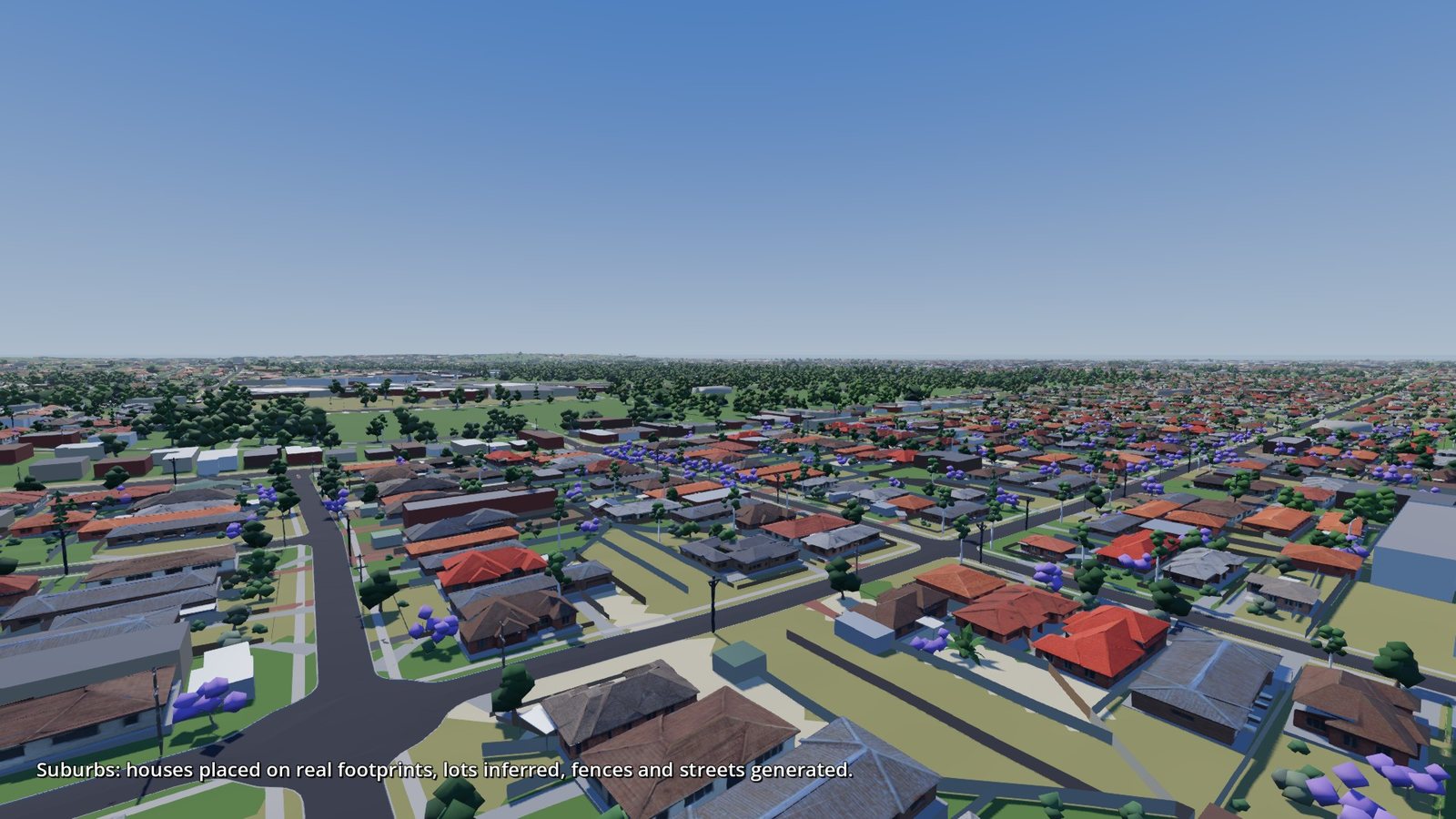
With the kit and the trees mounted through the streamer, the suburb stops being boxes. Red and grey tiled roofs, brick walls, pale verges, fences along the lots, a tree on most frontages. From a few hundred metres up it reads as Perth.
It is a stand-in look, and it helps to say what kind:
- Everything is opaque and low-polygon, because that is what mounts in one step. The style is a consequence of the streamer, not yet an art direction.
- Few materials: the kit's buildings, vehicles and props share two atlases and the trees share one palette. Fences, garages and the ground use a few dozen flat colours.
- Lit by the sun, its shadows and the sky only. Streamed instances do not yet take part in the engine's dynamic global illumination.
- Placement is from data: a house where there is a real footprint, a road where there is a real road, trees by assumed densities (there is no open canopy data).
What looks wrong is mostly known: houses stretched to fit their footprints, the same few shapes repeating along a street, flat-coloured ground, and no sign of the decade.
No windows at the level of detail placed in cells, no road markings, no retaining walls: houses sit on raw slopes. Lots at corners are wedges. This is today's city, not the 1990s one.
Next: road markings and kerb detail, more house shapes for large plans, and the first pass at what a 1990s street had that today's does not.